Nexus Journal Guide
Trading Journal Metrics Explained
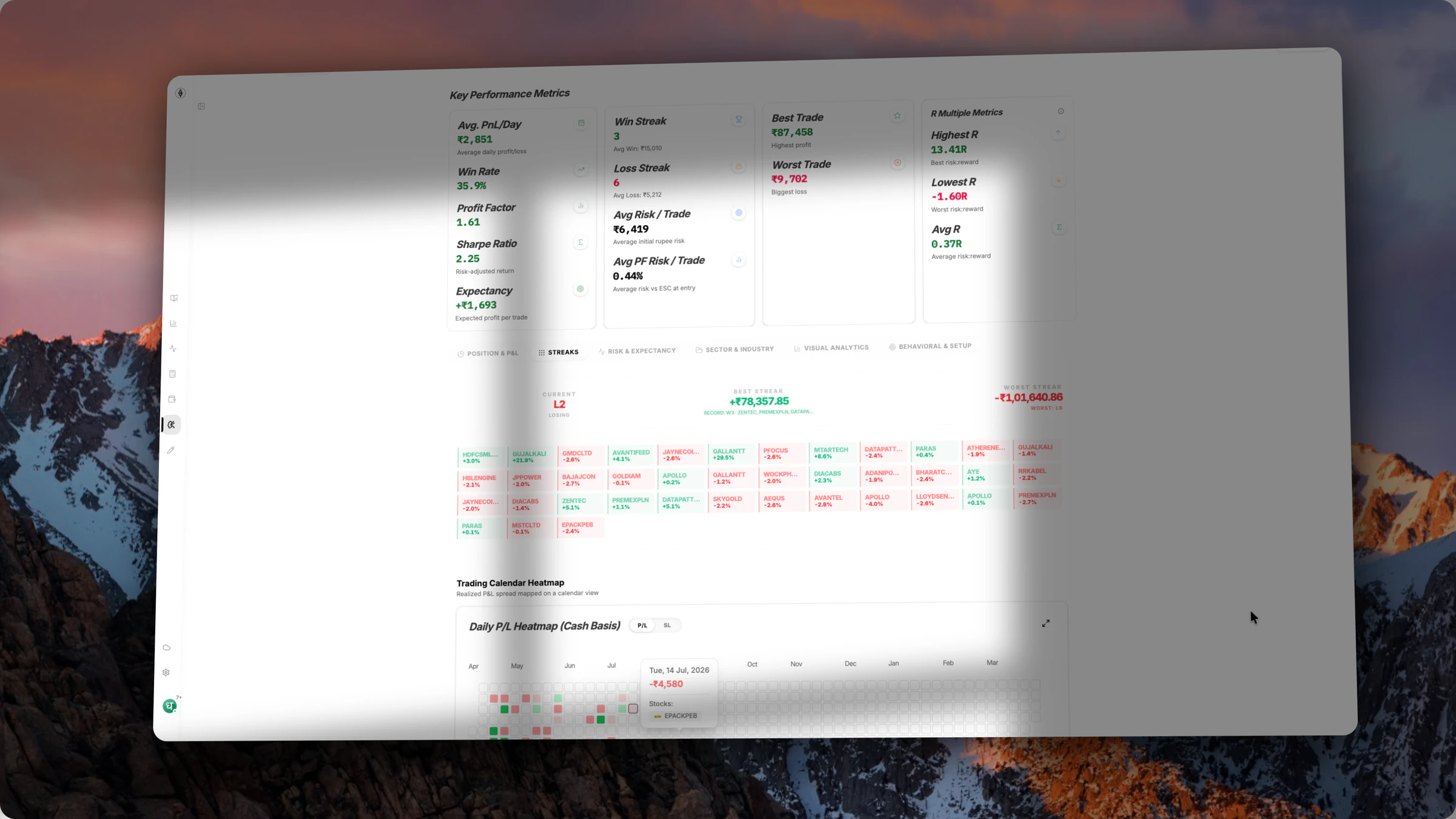
Nexus Journal uses trading metrics that explain risk, protection, drawdown, and realized performance. These metrics are meant to help a trader understand what is happening inside open and closed trades, not just the final P&L number.
Reviewed 2026-07-15 by Nexus Journal product team.
Profit Risk
Profit Risk estimates how much open profit can still be lost if a profitable open position comes back to its stop or trailing stop.
It is different from capital risk. Capital risk is money that can move the trade into loss. Profit risk is existing open profit that is not yet protected.
Profit Protected
Profit Protected is the amount of profit that appears locked if current stop or trailing stop levels are above the effective entry cost.
This helps separate a profitable but unprotected trade from a profitable trade where the stop has already moved into a protective zone.
Profit Giveback
Profit Giveback compares peak realized P&L with current realized P&L. If realized profit peaked at 100,000 and later stands at 70,000, the giveback is 30,000 or 30%.
This is useful because a trader can be profitable overall while still giving back a large portion of earlier realized gains.
Current Drawdown
Current drawdown measures how far the current cumulative performance is below the most recent performance peak.
Nexus can show pre-tax drawdown and, where tax or charge data exists, post-tax drawdown so the metric reflects the real drag from costs.
PF Impact
PF Impact means portfolio impact. It converts trade P&L into a percentage of effective starting capital, making trades comparable even when absolute capital changes.
The goal is to show how much a trade moved the portfolio, not only whether the trade made or lost rupees.
Lot-by-lot matching
Lot-by-lot matching connects entry lots and exit lots chronologically according to the selected cost-basis method, such as FIFO or LIFO where supported.
This matters for pyramids, partial exits, and staged exits because the same final P&L can hide very different execution quality.