Nexus Journal Guide
How Nexus Journal Publishes Product and Trading-Journal Guidance
Nexus Journal publishes product documentation and trading-journal education to help traders understand supported workflows, calculations, limitations, and review practices. Content is checked against the implemented product rather than written only around search keywords.
Reviewed 2026-07-15 by Nexus Journal product team.
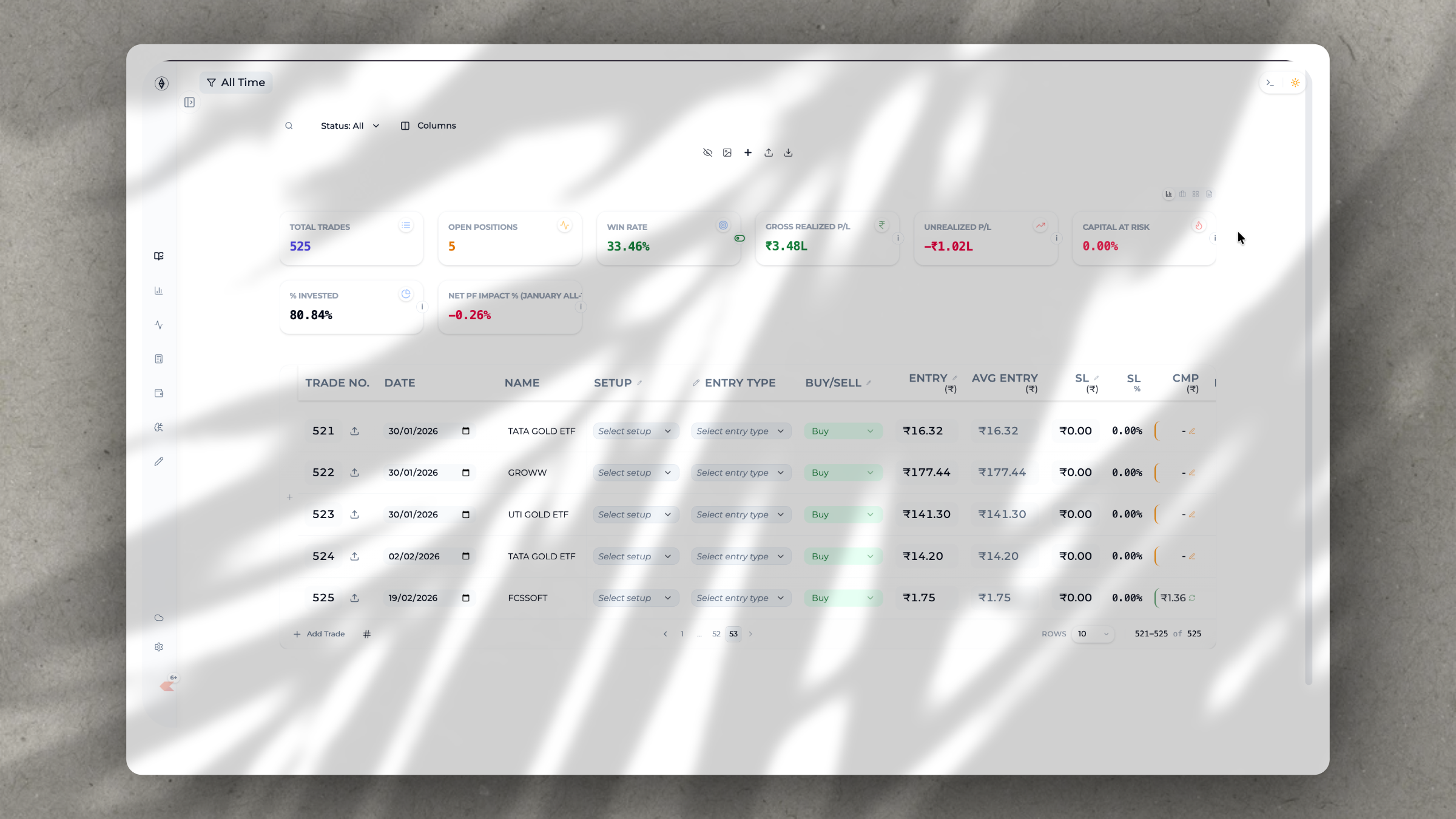
Evidence standard for product claims
A broker, import, metric, storage, or market-support claim should be traceable to a current application path. Marketing language must not turn partial, conditional, or file-specific support into an unconditional promise.
Screenshots, examples, formulas, and compatibility notes should reflect the current interface and active calculation path. Obsolete workflows should be removed instead of being preserved for traffic.
Authorship and review
Public documentation is maintained by the Nexus Journal product team. A page's review date indicates when its implementation-facing claims were last checked; it is not automatically changed merely to make old content appear fresh.
Broker formats and APIs can change independently of Nexus Journal. Users should reconcile imported results with the broker's official records before relying on analytics.
Financial and tax boundaries
Content about P&L, charges, risk, drawdown, or taxes explains how the journal organizes available user and broker data. It is educational product documentation, not a recommendation to trade and not regulated tax, legal, or investment advice.
Examples are illustrative unless explicitly identified as real, sourced data. No performance example should be presented as a promise of future results.
Corrections policy
Material inaccuracies should be corrected in the canonical page, its generated static HTML, Markdown twin, sitemap, and internal links together. This keeps human-readable and machine-readable representations aligned.
When a feature is removed or a broker workflow becomes unsupported, the page should be corrected or removed from discovery rather than left online as an unsupported acquisition page.